Position # 609473
Flagstaff, AZ
Service Professional
Closing: April 6th, 2026
Special Information
- This position is an on-site position which requires the incumbent to complete their work primarily at an NAU site, campus, or facility with or without accommodation. Opportunities for remote work are rare.
- This position is subject to the availability of funding. The incumbent is not eligible for Service Professional non-renewal notice, or Classified Staff layoff or recall status.
- This position is posted as Manager, Restoration Ecology & Forest Resilience, which is a working title. The NAU system title for this position is Manager, Research Project.
- Driving a vehicle on behalf of the university is anticipated to be a regular part of this position. Arizona Administrative Code Fleet Safety Policy requires all employees who drive on university business become authorized by submitting Driver’s license information for driving record monitoring, and completion of training appropriate to the level of driving performed. The law applies to all faculty, staff, and students who drive personal or university-owned motorized vehicles for any business purpose. More information on the NAU Authorized Driver Policy can be found on the NAU website.
About the Department/College
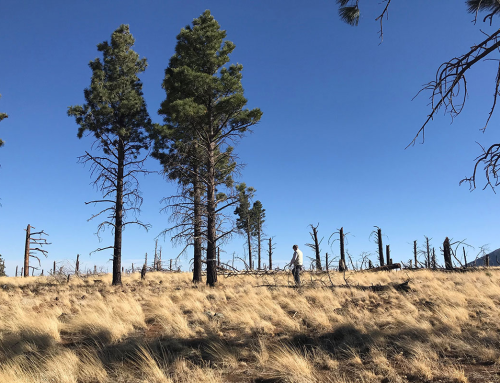
The Ecological Restoration Institute (ERI) Restoration Ecology & Forest Resilience Program Manager leads the day-to-day management, coordination, and delivery of ERI’s Restoration Ecology & Forest Resilience portfolio in support of ERI and SWERI goals. The position applies subject-matter expertise in restoration ecology, forest and fire ecology, and wildfire risk reduction to advance proactive, landscape-scale restoration, fuels management, and conservation in frequent-fire forests and woodlands of the Intermountain West.
About the Position
The Ecological Restoration Institute (ERI) Restoration Ecology & Forest Resilience Program Manager leads the day-to-day management, coordination, and delivery of ERI’s Restoration Ecology & Forest Resilience portfolio in support of ERI and SWERI goals. The position applies subject-matter expertise in restoration ecology, forest and fire ecology, and wildfire risk reduction to advance proactive, landscape-scale restoration, fuels management, and conservation in frequent-fire forests and woodlands of the Intermountain West.
The position oversees a portfolio of externally funded projects and associated staff that design and implement field-based studies, evaluate restoration treatments and fuels management strategies, and develop science-based decision support for managers and decision-makers. Work integrates field, inventory, and monitoring data with modeling and analytical approaches (e.g., wildfire behavior, fuels, and landscape or vegetation dynamics models) to inform treatment planning, adaptive management, and long-term resilience strategies.
Responsibilities include maintaining program work plans, timelines, and budgets; supervising and mentoring professional staff and students; monitoring progress and compliance requirements; and supporting reporting and deliverables across multiple grants and agreements. The Program Manager collaborates closely with ERI program leadership and external partners and represents ERI as a subject-matter expert in collaborative forums, while supporting program growth through synthesis, identification of emerging needs, and development of new initiatives aligned with ERI and SWERI priorities.
Responsibilities Include
35 % Program Management and Strategic Planning –
- Lead planning, implementation, and evaluation of ERI’s Forest Health & Resilience Program in alignment with ERI and SWERI priorities.
- Develop and manage multi-year projects and work plans focused on forest stand and landscape conditions, fuels and treatment needs, restoration prescriptions, and wildfire mitigation strategies.
- Coordinate project scopes, timelines, deliverables, and staffing across multiple grants and agreements related to forest health, fuels, and pre-disturbance resilience.
- Track progress toward milestones and adjust plans to meet deadlines and partner needs.
- Work with ERI leadership and other program managers to identify emerging needs in forest restoration, hazardous fuels management, and disturbance mitigation, and translate them into projects and externally-funded proposals.
- Contribute to development and refinement of program-level metrics to evaluate the impact of ERI’s proactive forest health and resilience work. – (Essential)
35 % Research, Analysis, and Technical Leadership –
- Provide subject matter expertise in forest and fire ecology, ecological restoration, hazardous fuels management, and/or ecological resilience in frequent fire forests and woodlands of the Intermountain West.
- Lead or co-lead design and implementation of field-based studies and monitoring that characterize forest structure, species composition, fuels, and treatment effects at stand and landscape scales.
- Lead or support use of wildfire behavior and fuels modeling tools (for example BehavePlus, FARSITE, FlamMap, QUIC-Fire) to evaluate treatment options, mitigation strategies, and likely fire behavior under alternative scenarios.
- Lead or support use of landscape and vegetation dynamics models (for example FVS, LANDIS-II, VDDT or SyncroSim) to explore long term trajectories, management options, and climate sensitive futures.
- Integrate modeling, field data, and partner knowledge to develop decision support products that help managers understand existing conditions, compare forest treatment alternatives, and anticipate future conditions.
- Lead and contribute to peer-reviewed publications, technical reports, guidance documents, and tools that synthesize current research findings for scientific, management, and policy audiences. – (Essential)
15% Collaboration and Partnerships –
- Build and maintain strong partnerships with federal and state land management agencies, Tribes, NGOs, local governments, and other research partners working on fuels reduction, restoration, and mitigation.
- Coordinate with the Human Dimensions, Disturbance Ecology & Recovery, Tribal Forest Stewardship and Restoration, and Forest Biomass and Wood Utilization programs to ensure that forest resilience, social science, tribal and post-disturbance research are aligned and not duplicative.
- Co-develop projects with land managers and other partners to ensure analyses, modeling, and monitoring directly inform planning, NEPA, treatment implementation, and adaptive management of western forest landscapes.
- Represent ERI’s Restoration Ecology & Forest Resilience Program in collaborative forums, workshops, and professional meetings
- Brief decision policy- /decision-makers on ERI and SWERI outcomes related to existing conditions, treatment effectiveness, and forest resilience – (Essential)
10% Supervision, Mentoring, and Team Development
- Supervise and lead research associates, research coordinators, and other professional ERI staff assigned to forest health, fuels, and resilience projects.
- Provide day-to-day direction, mentoring, and feedback to ERI staff and students working on field ecology, monitoring, modeling, and analysis.
- Support ERI staff and student professional development through training, peer learning, and engagement in publications and presentations.
- Participate in hiring processes for program staff and students as needed.
- Participate in hiring processes for program staff and students as needed. – (Essential)
5% Other –
- Attend coordination meetings among ERI, SWERI, etc.
- Contribute to ERI-wide initiatives, retreats, and strategic planning.
- Other duties as assigned. – (Marginal)
Minimum Qualifications
- Master’s degree in forestry, ecology, geography, natural resources, environmental sciences, informatics or closely related fields.
- 1 year of project management experience or supervisory experience
- 2 years of relevant experience
*A combination of related education, experience, and training may be used as an equivalent to the above Minimum Qualifications.
Preferred Qualifications
- PhD in forestry, ecology, geography, environmental sciences, or a closely related field with emphasis in forest and fire ecology, fuels, or forest health in frequent fire ecosystems.
- Demonstrated experience leading field-based forest ecology or fuels projects, including design and implementation of stand and landscape-level sampling and monitoring.
- Experience applying wildfire behavior and fuels modeling tools (for example BehavePlus, FARSITE, FlamMap, QUIC-Fire) to evaluate treatment options, mitigation strategies, and fire behavior scenarios.
- Experience applying landscape or vegetation dynamics models (for example FVS, LANDIS-II, VDDT or SyncroSim) to explore long term forest and fuel trajectories, treatment alternatives, and climate sensitive futures.
- Evidence of advanced skills in quantitative analysis and spatial analysis using R or Python and standard GIS tools, and in integrating field, inventory, and remote sensing data.
- Demonstrated experience supervising and mentoring staff and students on field ecology, fuels, or modeling projects.
- Demonstrated success contributing to or leading proposal development and securing external funding.
- Experience collaborating with federal and state land management agencies, Tribes, NGOs, and academic partners on forest restoration, fuels reduction, or wildfire mitigation projects.
- Record of peer-reviewed publications, technical reports, guidelines, or decision support products that inform forest management, fuels work, or policy.
Knowledge, Skills, & Abilities
- Forest and fire ecology, hazardous fuels management , and ecological resilience in frequent fire forests and woodlands of the Intermountain West.
- Silviculture and ecological restoration treatment approaches relevant to upland dry forests and associated woodlands.
- Wildfire behavior and fuels modeling concepts and tools, and their appropriate use and limitations.
- Landscape and vegetation dynamics modeling concepts and tools, and their application to planning and scenario analysis.
- Research design, sampling, and statistical methods used in field ecology, monitoring, and modeling studies.
- Budgeting and project management principles in a sponsored projects environment.
- Program development and execution, including planning, organizing, coordinating, and evaluating complex projects with multiple collaborators and funding sources.
- Field ecology and monitoring skills, including development and implementation of protocols for forest structure, composition, and fuels sampling and measurement.
- High level proficiency in quantitative analysis and data management using R or Python, and spatial analysis with GIS tools.
- Skill in integrating field data, inventory data, remote sensing, and modeling results into clear and actionable products for managers.
- Strong written communication skills for technical and non-technical audiences, including production of peer-reviewed articles for professional journals, technical reports, guidance documents, and decision support materials.
- Strong oral communication and facilitation skills for scientific, management professionals, and community audiences.
- Skill in supervising, mentoring, and leading regular staff and students.
- Skill in building and maintaining collaborative relationships with agencies, Tribes, NGOs, and other partners.
- Ability to work both independently and as part of interdisciplinary teams, manage multiple projects and deadlines, and exercise sound judgment.
- Ability to translate complex science information into clear, decision-relevant insights for managers and policy- /decision-makers.
- Ability to identify emerging forest resilience issues and develop programmatic responses that advance ERI and SWERI goals.
- Ability to contribute to a positive, inclusive, and collaborative work environment.
- Ability to travel to field sites and partner locations and work in variable outdoor conditions as needed.
Compensation
Salary range begins at $76,082.00. Annual salary commensurate with candidate’s qualifications and related experience.
Pre-Employment Check
Northern Arizona University requires satisfactory results for the following: a criminal background investigation, an employment history verification and a degree verification (in some cases) prior to employment. You may also be required to complete a fingerprint background check. Also, as an employer in the state of Arizona, NAU is required to participate in the federal E-Verify program that assists employers with verifying new employees’ right to work in the United States.
This position has been identified as a safety/security sensitive position. Therefore, per AZ Revised Statute, Northern Arizona University requires satisfactory results for the following: a criminal background investigation, employment history investigation, degree verification (in some cases) and fingerprinting. If you are applying for a job that requires a CDL, you will be required to register with the Federal Motor Carrier Safety Administration Drug & Alcohol Clearinghouse and adhere to the clearinghouse requirements.
Notice of Availability of the Annual Fire and Security Report
Each year Northern Arizona University releases an Annual Security Report. The report is a result of a federal law known as the Clery Act. The report includes Clery reportable crime statistics for the three most recent completed calendar years and discloses procedures, practices and programs NAU uses to keep students and employees safe including how to report crimes or other emergencies occurring on campus. In addition, the Fire Safety Report is combined with the Annual Security Report for the NAU Flagstaff Mountain Campus as this campus has on-campus student housing. This report discloses fire safety policies and procedures related to on-campus student housing and statistics for fires that occurred in those facilities. If you would like a free paper copy of the report, please contact the NAUPD Records Department at (928) 523-8884 or by visiting the department at 525 E. Pine Knoll Drive in Flagstaff.
Immigration Support/Sponsorship
Northern Arizona University will not provide any U.S. immigration support or sponsorship for this position.